Friday, November 10, 2006

In Remembrance …

Just days before the observance of Remembrance Day, on November 11th, an article has appeared in the Canadian Press indicating just how out of touch with reality some veterans can be. I have the greatest respect for the veterans who have served our nation, especially in recent peacekeeping missions, but Remembrance Day is most especially about the observance of those who gave their lives in the “Great Wars”, though I bristle at calling the “First World War” anything more than an expression of everything that was wrong with the psychotic Imperialistic and royalist systems that had a stranglehold on world politics at the time.

That the assassination of on idiotic Arch-Duke should lead to the death of millions indicates a sign of a serious problem, not one that can be resolved by war, but one that must be dealt with through other means.

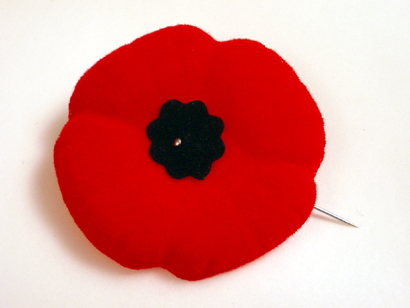
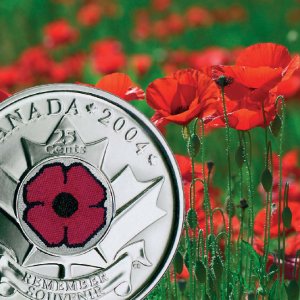
Morality of war notwithstanding, the accepted symbol of Remembrance Day has always been the red poppy, adopted because of the poem by Canadian Lieutenant Colonel, John McCrae (1872-1919), who wrote the famous poem “In Flanders Fields” while serving as a physician during WWI. The poem was written out of the experiences that McCrae witnessed, including having had to bury a friend the day before he wrote the text. In the end, he died from what ended up killing more than the bullets being fired: he succumbed to pneumonia and died in 1919 after a short illness.
So why should a Canadian Press article be of any importance? For the simple reason that it points out the fact that the Canadian Legion is objecting to the fact that a group of people in Edmonton have been selling white poppies with the word “peace” in the centre as a symbol of their love of peace. The red poppy is seen everywhere during the period leading up to November 11th, and everyone in Canada who has been conscious for more than one year knows what it represents, so why should there be a problem with a white poppy that says peace?

It seems to me that the Canadian Legion, the organization that represents those individuals who have witnessed, first hand, the horrors of war, would be willing to do anything to prevent another generation from having to become members of their organization, but instead, the group in Edmonton has encountered intense resistance from Legion officials.
Harvey Shevalier, president of the legion's Alberta-Northwest Territories Command, said the poppy is a registered symbol of the legion and can't be used without permission. "The legion cannot condone it, and we cannot accept any attempt to use this poppy without authority or approval," he said.
Now wait one second … the poppy may be a registered symbol, but that is the RED poppy … these guys didn’t use that one, did they? The Legion went on to say that using Remembrance Day as a “focus for a fundraising project of promotion of an ideal is completely inappropriate and unacceptable”. Now that, my friends, is the height of hypocrisy. For the month of October the Legion has their volunteers out in malls selling poppies to people. Selling; for money. Money, a substance used to pay for things, something that is used to keep organizations running.

The Legion says that this is the wrong time for fundraising, yet they do that for an entire month, and how is their displaying of military regalia at some of their sale sights not a promotion of a specific ideal? Having veterans dressed in their old uniforms with their medals is not what you can call a subtle hint that Remembrance Day is coming and you should buy a poppy from them, if you haven’t done so already.
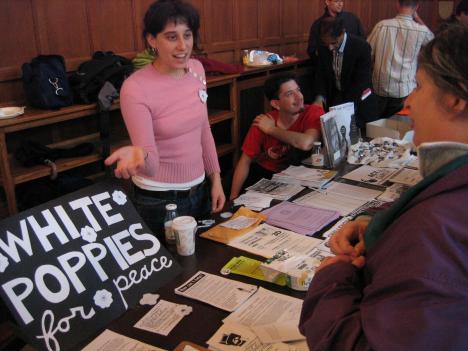
Thus, what must truly be objectionable to the Legion, which is the most puzzling thing of all, is that they must be opposed to the fact that this group in Edmonton is using their poppies to spread a message of peace, a message that does not have to be delivered with the destruction of life attached.

When I first learned the lines of this immortal poem, as a child in grade school, the imagery that the poem conveyed to me was that of soldiers who had gone to the grave and were making these flowers grow by virtue of what they were contributing to the soil: the blood from their veins, the blood that had, only hours or days before been coursing through living, vital young men. My impression had always been that the poppies were red, blood red, because of the blood that had been spilled so copiously on the battlefield, a battlefield that was bleak with the stink of death that haunted every living thing that dared to enter its environs.

As a physician, a man dedicated to healing lives, not taking them would it be difficult to imagine that Lt. Colonel McCrae would have been offended by the symbolism of the white poppy? I rather think he would find it quite appropriate and more than fitting. The white poppy is not only a legitimate symbol of peace it still a symbol that represents the nearly 117,000 Canadians who died in war.

If all we do is remember those who died in war, Remembrance Day may as well be scratched off of the calendar: we must actively recall the full aspect of what war represents. It isn’t enough to talk about the sacrifices that Canadians made during the war, though this is something we must observe, and our veterans must be lauded and given everything that is due them for the service that they have provided this nation (and, in some cases, humanity). At the same time, when children learn about Remembrance day in school they must learn about the truth about wars, and about what is going on today, and about the forgotten “war” that is being forgotten and covered up by the press in the middle east while attention is focused on Iraq.

While the news services went crazy covering the midterm elections in the United States they had a perfect excuse to ignore the ongoing slaughter of innocent civilians taking place in Israel, all in the name of “self defence”. This is war, and should be observed on Remembrance Day. When I stand for my moment of silence at the 11th hour on the 11th day, this Saturday, my thoughts and prayers will be with those who have lost their families in the war being waged by the Zionist fascists in Israel.

Until every war has ended, until every citizen of the world can go to bed at night without the fear of some psychotic military officer ordering the firing of a few artillery shells at your house because it seemed like a viable target – the day before – until then, Remembrance Day is a day to remember that a lot of soldiers have died. We know that as a result of their sacrifice the Third Reich did not last nearly as long as its architects had planned, but other than that, what is different?
As for the justice offered, or the veneer of peace in which we are supposed to be enjoying, that is all it is, a veneer: while one form of oppression has been replaced by another for many people in the world, the poppies continue to grow, the ground being fed by fresh blood with the passing of each day … and governments close to home continue to profit from war, almost as though it is a national industry.

The one lesson we need to all take from the words of John McCrae is that there is not one single day for which we should be setting aside a moment to remember what it is we have as a result of the sacrifices of the veterans, and, consequently, what the horrors of war visit upon humanity.
“If ye break faith with us who die
We shall not sleep,
though poppies grow
In Flanders fields.”
By “breaking faith”, could that possibly mean taking for granted the liberties we enjoy? Perhaps it would be a break of that faith to say to another group that using a white poppy with the word “peace” on it was something that was unacceptable at a time when we should be also repeating the words “never again”, and meaning them. No, it is, I fear, the Legion itself that has broken the faith and dropped the torch, having forgotten what the symbolism that McCrae was searching for truly meant.

As you read the poem just try to imagine yourself after Second Battle of Ypres. During an artillery attack a friend of yours is killed, and you, in lieu of a military chaplain bury him and perform the service. Then you write this poem …

In Flanders Fields
by John McCrae, May 1915

In Flanders fields the poppies blow
Between the crosses, row on row,
That mark our place; and in the sky
The larks, still bravely singing, fly
Scarce heard amid the guns below.

We are the Dead. Short days ago
We lived, felt dawn, saw sunset glow,
Loved and were loved, and now we lie
In Flanders fields.

Take up our quarrel with the foe:
To you from failing hands we throw
The torch; be yours to hold it high.
If ye break faith with us who die
We shall not sleep,
though poppies grow
In Flanders fields.

(Here is a link to a related BBC article, bringing the issue of religion into the debate.)

Wednesday, November 08, 2006

Too few decide for Many

With a population of 300 million people there should be a fairly large voting base in the United States to call on when it comes to deciding who will lead the government, making the decisions that will effect the lives of every member of society, as well as the rest of the world. Unfortunately, in the midterm elections that took place on November 7th there was an astounding turnout that was skimming forty percent.

Does this mean that sixty percent of Americans have given up, surrendering to the Fates? Or, as an alternative, have they decided that it is a good thing to have a small majority of the people decide how the entire country (and, again, the rest of the world through the results of their foreign policy) will live? Either way, it is a pathetic display from a land that declares itself to be – at every possible chance – the ideal model of democracy.

The United States has developed a megalomaniacal obsession with the idea that their version of democracy should be the model that every country in the world aspires to copy. It is what they want to install in Iraq, which is why, having had their own civil war in the darkest part of the Republic’s history (or, what should have been the darkest part … this may be changed soon) there is so much emphasis from the Bush administration on denying that the sectarian violence taking place in Iraq is, in fact, a civil war. Iraq, post-Saddam, is developing into an American-style democracy: there is an abundance of corruption, violence and political impotence to control the situation.

Is it any wonder the Iraqis want something just a little bit better than that? After suffering the ravages of years of war that Saddam waged with Iran and the internal conflicts, not to mention the first Gulf war, one would think that the people of Iraq deserved the best form of government available. This is where America begins to falter in their mission. While military muscle may be impressive, and it is always awe inspiring to know that you are dealing with a nation that can eradicate every living organism on the face of the earth several times over (a truly laudable ability indeed), that doesn’t automatically translate into the ability to create a democracy out of an dictatorship.

After all, we must remember that this is the same country that, in the not-so-recent past removed democratically elected political leaders and installed dictators into their positions. Democracy, for the United States, is something that ends up being quite ephemeral, serving their purpose so long as it is convenient, but never getting into the way of their actual agenda. The recent signing of the Military Commissions Act by George W. Bush is a perfect example of this fact.

With the simple act of signing this Act into Law, the president effectively eradicated the right of habeas corpus. This is a right that is enjoyed in common law countries and is a protection for the citizen from being abused by the judicial system. The Military Commissions Act makes it possible to simply suspend this right, something older than the Constitution of the United States, older than the United States and any other North American nation. Habeas corpus was first used in 1305 during the reign of King Edward I but it wasn’t until the Habeas Corpus Act was passed in 1679 that the rights that it represented were fully codified.

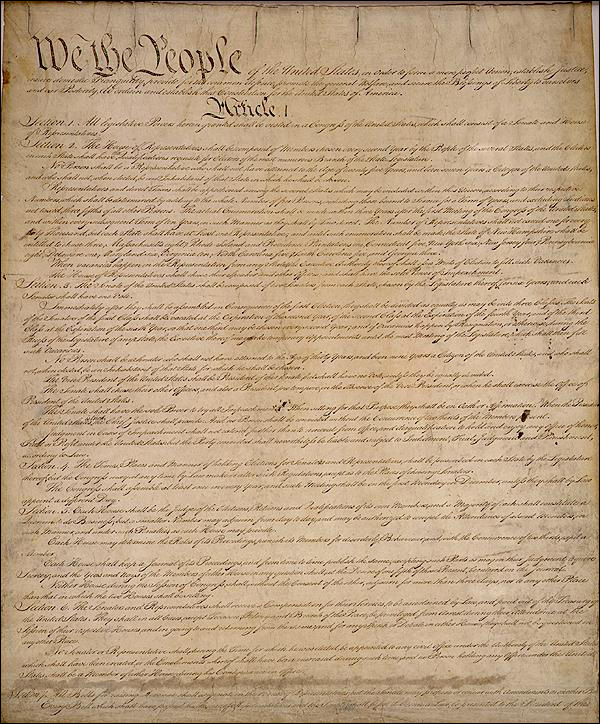
The framers of the Constitution thought so highly of it that they decided it should actually be mentioned, not as a special amendment, but within the body of the document itself. It is codified as a part of the United States’ laws within Article One, section nine. “The Privilege of the Writ of Habeas Corpus shall not be suspended, unless when in Cases of Rebellion or Invasion the public Safety may require it.”

The United States has not been invaded. There has been one attack, five YEARS ago, and then some mailings of anthrax. Nothing else. A fictitious war has killed more Americans than the one attack on American soil that has taken place since Canada crossed the border during the war of 1812 (and whipped their asses). Any suspension, at this point in time, of the “Privilege of the Writ of Habeas Corpus” is, to borrow a term that the Republicans love, an abomination.

It is a perfect representation of the type of democracy that the United States has, and exactly why this is not the democracy that should not be held up as the model for the world. As a model of what not to do, certainly, but as a guide to run a country; only if you want to have a genocide in your nation (slaughtering the indigenous peoples of your nation, or, in lieu of them, a neighbouring nation … or the Jews, they are always a good choice), then you would have to make sure that you craft your foreign policy so that it allows genocides to take place in other nations while you only intervene when it serves your own interests (as the United States did during WWII, allowing the slaughter of the Jews until they began to realize that Hitler was more of a menace than they realized so it was expedient for them to become involved … Pearl Harbour having nothing to do with the decision).

Machinations. Democracy. Two words that should never appear within the same sentence, but, alas, could many times over when discussing the state of the American version of democracy. Whenever government is warped so that it serves those who are in office rather than the people who are supposed to be served by them, there is a problem that is greater than belief. When the vice-president has such a close relation with the company that is making – literally – a fortune from the war, well, how can that be reconciled with anything?

Even so, when all is said and done, the voters, the few that turned out, sent a clear message to the Bush administration: it is time for a change. The Democrats are now in control of the Senate and, pending the result of some races still being counted (one of which looks like a pretty sure Dem. win), they may also have control of the Congress. Many of the gubernatorial races also resulted in Democratic victories, although California decided to stick with the Terminator as their man in Sacramento. There are now 28 Democratic states and 22 Republican states: these are Governors and does not necessarily translate into electoral college votes, though it does represent over 306, which is far more than the 270 needed to become president, but it certainly is promising.

One interesting thing happened, and it probably caught everyone off guard as well: the state of Minnesota elected a Muslim to the Senate. Keith Ellison has become the first Muslim to have ever been elected to the Senate in history (and he’s black … oooh …). The House of Representatives may have to start allowing women in next … oh right … they did that already.

Perhaps, with a sign of such enlightenment – and tolerance – in two years there will be something else truly worth celebrating … so long as the Republicans keep screwing up (something that shouldn’t be too hard given the current situation and the ongoing debacle in Iraq), and if the Democrats don’t do anything too stupid … (a hard thing to ask for, but one can always be optimistic), who knows, it has happened in the past.

In the meantime, we must be relentless in our efforts to change the minds of these elected officials: even if you aren’t a citizen of the United States, you can e-mail elected officials and send them your concerns regarding world issues. I have been on the mailing list of Senator Clinton for over one year and have sent her several messages, including several regarding the United States and Israel. All you have to do is go to the home page for the Senate and find the individual you are interested in (the new House of Representatives reconvenes in January). Their email address is listed (it goes, in all likelihood, to their deputy communications secretary, or someone with a sufficiently stuffy title). While you may not get a personal answer, so long as you are able to send civil, well reasoned messages, you can be sure that it will be brought to their attention – the one thing that politicians do fear is having something come back from the past, like a message, and be told, “well, you were told about this in a message three years ago,” or, “the memo was titled ‘bin Laden intent on …’”.

If we do nothing, believing that our actions will bear no fruit, we have fulfilled our own prophesy.

Tuesday, November 07, 2006

When did Teenagers turn into Sociopaths?

Whatever happened to the concept of young people, in this case someone who was barely a teenager, from listening to the advice of their elders?

First of all, let's get one thing straight, now that I am 38 I have come to the sober realization that the youth of today see me as being old, and I see some of them as being quite annoying (not unlike the way I viewed my elders in my youth, without the lack of respect part though).

This morning, while taking the bus downtown, I was confronted with the latest situation in a long line of examples that could be tabled as "exhibits for the prosecution". While sitting, reading my book ("Synchronicity" by C.G. Jung), a rather slightly built youth took his place in front of me and began his ride holding onto the strap which was right in front of me instead of taking hold of the pole which was directly in front of where he was standing.

As soon as the bus turned around its first corner the expected happened: the boy bumped into my book (no acknowledgment or apology, of course), and he nearly fell over, bumping into the passenger behind him. Observing this I offered him some advice.

"Why don't you hold onto the pole instead of the strap, the pole doesn't move while the strap does." Having said this he gave me a bemused look, then proceeded to expound upon the merits of the strap, until I interrupted him. "Yes, but you have already hit my book once, as well as other passengers."

"Have I?"

As he launched into another dissertation on strap-pole qualities (while losing his balance) I returned to my reading, saying, "this isn't a conversation, I was offering an observation and an opinion."

As expected, when he and his friend exited the bus I could hear the derisive laughter of the boys, though I couldn't make out anything past "who does he ..."

Well, that is a question that can be answered, even without having heard it in its entirety. I was merely another passenger on the bus, trying to get to my destination without being accosted by another rider. As soon as this boy got on the bus he was a menace. His over-stuffed bag hit several people, including the driver (I was sitting at the very front and saw him get on), and he dropped it on my knee while putting it down, again without even acknowledging that he may have done something wrong. I'm not writing this because of my knee, however, but rather because of his absolute refusal to accept any offer of an individual's opinion from someone who may just have had a bit more experience than he does.

This is the thing that amazes me the most about these kids: they talk and act as if they know absolutely everything about everything, while, in point of fact, they often end up having "book jacket knowledge". That is the type of knowledge that you can glean from a book by reading the inside and outside covers, without having to waste your time by actually reading the work itself.

During the summer I encountered a perfectly precious example of this while in one of my favourite places to write, the coffee shop near my chiropractor's office (I'm not going to plug the store as the new owner is turning the place into a rather unpleasant place to sit in and spend some time, which is the exact opposite of the previous manager’s philosophy, so I feel no loyalty towards it anymore ... but that's another story for another time). While I was there writing there was a clutch of young people deeply involved in a rather heady discussion regarding various religions and other belief systems. They were also having a discussion, after a time, about the theological differences between the monotheistic faiths, discussing the natures of Islam, Judaism and Christianity, with some forays into some other religions as well.

I wasn't trying to overhear their conversation, but they were sitting right next to me, so it was quite difficult to ignore them, which was why I couldn't help but overhear the errors that they were espousing with such confidence as being factual. For some reason, perhaps because of my upbringing, I seem to be overly sensitive to the presence of misinformation and feel the need to correct the matter if I am able. In the case of the discussion regarding Christianity and Judaism, it seemed that I was able to contribute far more than any of the youths were, and my rudimentary knowledge of Islam (the result of one course in during my undergraduate degree) also dwarfed the self-confessed "expert" of the group who knew nothing of the historical background of the religion.

This group, unlike the boy on the bus this morning, was more than welcoming of my opinions when I made a small comment and ended up joining their conversation. We ended up talking for well over an hour, and in the end I was the one who had to leave due to another engagement. Where one group of teenagers does not feel threatened by listening to the opinions of someone older than they are, another does ... but why?

This morning, when I spoke to the boy on the bus, I was smiling and not yelling, there was nothing at all threatening about what I was saying. The thing that bothers me the most was that he didn't even consider the merit of the idea, while still losing his balance, while still hitting other passengers. Even as he got off the bus he was staggering around, not holding onto anything.

Is this the direction that our society is heading? Given that the adult electorate of our country has elected placed a minority neo-conservative government that is a virtual puppet of the Bush administration, I have to wonder. Then there is the progeny of the United States: a country where the voting public elected a pathological liar to a second term of office even after his lies and deceits were fully, if not wholly, revealed and exposed to the public ... who conveniently decided to ignore the truth and vote according to the fear mongering that was taking place through the Bush administration’s version of the Minister of Propaganda and National Enlightenment, a title borrowed from Herr Goebbels, the ultimate propaganda master. Bush has had his cronies masterfully use the threats of further terror attacks to galvanize the fear of the people into believing that they were only safe with a Republican in the White House, as well as a Republican controlled Senate and Congress.

If the youth of today are unable to listen to the opinions and ideas of their elders, how are they doing in school? Are they listening to their parents at all? What sort of citizens are they turning out to be? Considering that I have seen (also on the bus ... I take the bus, I don't drive) little children acting like maniacs on crack while their mothers (or fathers – or both) sit idly by, talking to their friends, or on their cell phones completely ignoring their children.

Why are these kids acting the way they are? For the simple reason that they are starved for the attention of their parent and, if they cannot get it in a positive manner they will act up until they get punished. I know that sounds crazy, but it is a psychologically proven fact, even negative attention is preferable to a child than none at all.

So, what sort of teenagers will these kids grow up to be? That, alas, is an easy answer to provide: in a word, hoodlums, but that is an oversimplification of what is really happening. We are in danger of losing an entire generation, if not more, of our youth through passive neglect.

I call it passive neglect for the simple reason that these kids are well fed, they have homes and everything that they need, if not more, except for the parental affection that cannot be substituted for with anything else. Passive neglect leads to many things, including the seeking out of gangs, which offer a "family" substitute. It also leads to the use of illicit drugs as kids search for the feelings they never had, but know are supposed to be there, somewhere. It leads to early sexual promiscuity as, again, kids seek substitutes for the affection that they don't know, and worse than ever, it can lead to the development of an anti-social personality which, at its worse, can lead to the most violent type of sociopathic behaviour – the ultimate menace to society.

We know this for simple reasons: the brutality of Romanian dictator Nicolae Ceausescu’s brutal regime, which resulted in thousands of unwanted children being abandoned in orphanages across Romania. These forgotten children were kept in the filthiest of conditions, receiving on the barest essentials for survival. Those charged with their care were so overworked they did not have time (and perhaps the inclination) to go any further in the care of the children ... and if they did, it was too little, too late. These children spent countless hours in their cribs, lying in their filth and crying incessantly for hours without receiving the calming touch of another human at all.

When these children began being adopted by childless couples from North America in the 90's it was soon discovered that their was something very wrong; the fulfilled dreams of these couples came with an unexpected burden that all the love in the world couldn’t seem to repair. Their children were severely scarred by their early childhood experiences, scarred in a place that doesn't heal as easily as the body, scarred in their minds.Many were so severely effected by their ordeals that their adoptions were reversed, the child proved to be too much for what the family had been prepared to provide.

If the parents of today who use their televisions, computers and other forms of electronica as babysitters continue on their course in child rearing their is the very real possibility that the only difference between our children and those brought here from Romania will be that the Canadians (and Americans) will, for the most part, have been better fed and educated, but their social skills will be barely above those of children who have had no socialization at all.

We have to start making the distinction between kids going out and being "social" with each other and actually being able to interact in a social situation without acting like savages amongst other humans. That is one of the most important skills for living, and it is one that will prepare them well for the struggles they will face in the real world once they discover that the artificial world of academia is far more sheltered than they could have imagined. I cannot count the times that I’ve been on the bus in the afternoon going home when there are several teens who get on, having just gotten out of school. Now I understand that everyone is excited about the end of the school day, I remember what that was like, but is it really necessary to scream, at the top of your lungs, while the person that you are talking to is sitting right next to you? Even when I put in earplugs that are very effective, it is still loud. This is not merely a sign of poor socialization; it is an indication that these kids have no idea that there is a proper way to act in public, especially when you are in an enclosed space like a bus (not even mentioning the fact that their actions could have distracted the driver, endangering the lives of everyone on board).

Even as I write this, I can't help but think of the young voters casting their votes in the United States today, and those who have the opportunity to vote in the municipal elections here in Ottawa next Monday. When I was young I looked forward to turning 18 the way some kids looked forward to turning 16. I had no interest in driving (I still don't have a license, and don't want one ... it doesn't do me any good since my Jag died ... right) ... no, I wanted to be able to vote!

It has always been the greatest pleasure to be able to participate in "the process", if only for the reason that I feel it gives me the right to voice my opinion about government without reservation – after all, I helped in the process. It has always amazed me how some people will go crazy talking about politics, but when you ask them if they vote, they quickly say, "I don't vote". Well, what kind of idiocy is that? How can you not vote, yet you want to spend so much energy complaining about things? Hubris, that is the word.

That is when I freak people out (a personal hobby ... and it costs nothing). "If you don't vote," I say, "you abdicate your right to complain about the system." That usually leaves people with their mouths hanging open (the word abdicate causes the hang-up, so I oblige them). "Voting is your duty as a citizen and gives you the right to complain about what YOUR government is doing. If you don't vote, they aren't your government."

That does it.

"But, I pay taxes," they sputter, indignant and embarrassed.

"Yes, but why don't you vote? Were you unable to get to the polling station, because if you were, you can call one of the candidates and they will eagerly arrange a ride for you on Election Day? If the day of the election was inconvenient there are several advance polling opportunities, and there is always the proxy vote as a last resort. Voting is what makes a democracy work. If the people can’t be bothered to care enough to get off of their complacency and help decide who their government is going to be, then a small, often narrow minded minority of those eligible to vote will make the decision. The smaller the sample that votes, the less representative it is of the actual views of the electorate. That is why it is so crucial to have as high a turnout at the polls as possible.

Besides, what message does it send to the youth of today when they see such voter apathy in the adults of today? When federal voter turnout skims 70%, what does that say? What would have happened if 100% of registered voters turned out to vote? What would happen if voting was a legal obligation, as it is in the Netherlands and New Zealand, where voter turnout is in the high nineties?

Only then will we see what the term "Democracy in action" truly means. Then, when the youth of North America sees that the adults are being responsible for what is going on around them, perhaps they will be a bit more receptive to what we have to say to them (either that or we have to start beating them ... that could always be a standby option).